
I'm concerned about secrecy in government — which is a natural reflex of any bureaucracy but is most egregious in the current Bush Administration. Now, due to an error at the Justice Department, we have an opportunity to compare the original version of a report on discrimination with the censored version:
"Too much information was withheld," says FAS's Steven Aftergood. "Information that was purely factual was censored as if it were deliberative...We want agencies to be able to discuss different policy options and to make recommendations outside of a charged political environment, and the deliberative exemption allows them to do that. But the exemption does not apply to factual material."
For example, a section of the text notes, "sexual harassment is not perceived by attorneys to be a problem in the Department, but racial harassment is." That should never have been cut from the public version, says Aftergood. "That's something that ought to be made publicly available."
Much, if not most, of the scores of blacked out pages should have been released under law, Aftergood says. He credits the PDF blunder with exposing a systemic problem in the Justice Department's FOIA compliance, and he hopes an internal review will result in an overhaul of the system. A Justice Department spokesman declined to comment on the matter, and the almost-censored document disappeared from the department's website Wednesday afternoon.
- Kevin Poulsen, Justice e-censorship gaffe sparks controversy
The remnants of puritanical influence are embedded in various aspects of Boston life. For instance, on a Sunday one can't buy a bottle of wine to take home for dinner. Granted, I can see it causing some inconvenience when one's last bottle has gone a bit sour and friends are coming over. But for those folks that bitterly complained about the restriction, I figured if you are too stupid to plan ahead a day, maybe you should be cutting back in any case!
 With some slight home-sickness, I've been emailing friends in Cambridge, to see how things are going. So I'm touched that Wendy was kind enough to think of me, and Jen notes they've had their first snow! That seems early even for New England standards.
I always associate the first snow with Thanksgiving. For a couple of years, as I left Boston to visit family in Baltimore I'd notice the first flakes falling while waiting at a subway station or looking out at my soon to depart plane.
Nora and I have been spending the holiday together for the past few years. So now instead of travelling, the first flakes visit me as I frantically search for the last can of cranberry sauce on the surprisingly dark and quiet Thanksgiving eve.
I wonder what my present neighborhood will look and feel like in the winter.
I live about a block away from The Grocery, a little restaurant here in Carroll Gardens. I'm also good friends with a server there and I was surprised to note that one of her tables has become a topic of blogosphere conversation. Zagat recently listed The Grocery as the 7th best restaurant in New York. The New York Times food critic William Grimes felt some need to rationalize his previous single star, On Second Thought: It's Still Quite Good, wherein he reverts to a high/low art distinction:
By the same token, the perfect three-minute pop song cannot grip the imagination and hold it the way a three-minute polonaise by Chopin can. Subtlety, finesse and refinement deserve a higher score. Art trumps craft. The best bistro in New York should not be considered the equal of a Daniel or a Le Bernardin.
I never found this to be a compelling distinction in art, and definitely not for food. If the food is good and the environment is comfortable, I'm happy. Having a server standing nearby ready to pour water as soon as one takes a sip — as one might find in the "high art" establishments — might make some more comfortable, but not me. But that's a matter of preference independent of the quality of the food. Of course, I'm (personally) not likely to rate loud or non-vegetarian restaurants very highly, so I appreciate these issues are not completely divorcable. But glitz should not be a determining factor.
What all of this means for the little neighborhood "bistro" is their phone is ringing off the hook. And given CNN will be filming there tonight, I don't expect that to change any time soon.
 Today, awkward and stupid things happened. But I only smiled. This evening, the subway service was confused and delayed. When the car finally arrived, we crushed ourselves into its aluminum confines. A baby wailed, continuously. Those nearby rolled their eyes, grimaced, and discussed. I responded, "it adds to the surreality of the experience." Today was like watching my life on a TV show, with the volume turned off.
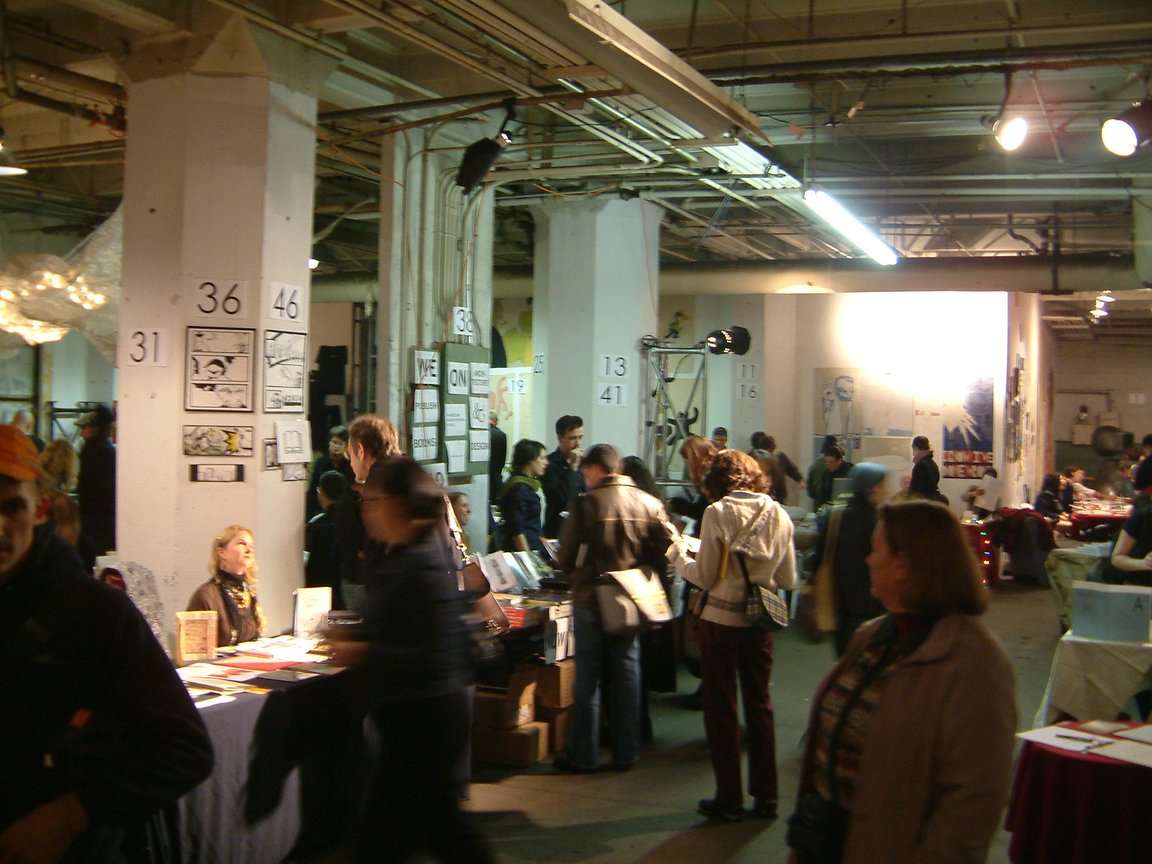 Yesterday, we stumbled upon the Cheap Small Press Fair at DUMBO Art Under the Bridge. I got to briefly meet Stacy Wakefield of Evil Twin Sister, a favorite zine of mine, and who I mentioned once before. Stacy lives in Brooklyn. This was fortuitous in that of all the cool people I've wanted to meet in Brooklyn, I haven't. So far, I've only crossed the paths of those that surprised me.
Ironically enough, part of what prompted my move to New York was a desire to settle down. To state, "here is where I'll call home," and include within my sense of identity an acceptance of things like home ownership, weddings, and the like. I had not yet completely accepted what was becoming more appealing because I was merely continuing a state of indecision. So in a way, my arrival here was a bit of a fling of impermanence and adventure that in any case would prompt me to make some sort of choice.
So I made a choice and now my fantasies about the future amuse me. They typically do not include the experience that is graduate school for however many more years; instead they are of returning to a happy life in Cambridge, or pursuing an even more extravagant lifestyle like becoming some sort of hippie and moving to Kauai or travelling across the country in an RV.
However, for the time being, I live in Brooklyn and go to NYU. And absent the presence of my old friends, the camaraderie of my W3C colleagues, and the comfort of neighborhood custom, I more than ever need a sense of something beyond my trivial self. Jason mentions his morning ritual, "Hatha yoga, meditation, and breakfast kickstart our bodies and souls. Then we read and discuss a short passage from the Pirkei Avot, the Ethics of the Fathers. It is a section of mishnah from the Talmud, and gets us thinking about spirit, about ethics, about our roots in Judaism..." I'm not sure yoga and Judaism is the thing for me (perhaps stretching and Buddhism?) but, yea, something like that. Before, when Jason was my roommate, I fear I was too lazy to take advantage of his practice. And now, I don't know where to start, and feel like I lack the time even if I did.
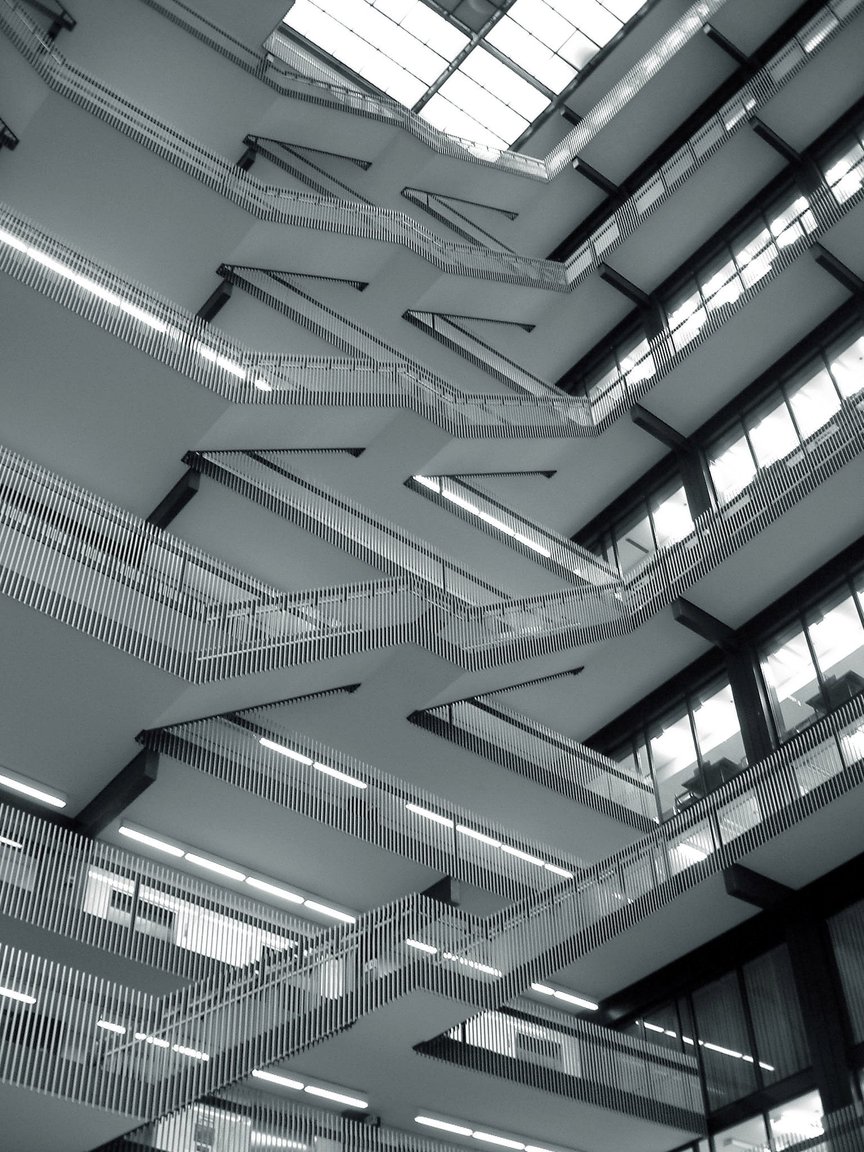 The fantastic atrium of the NYU library has been the location of two student suicides this semester. My reaction is multifaceted. I feel sorry for the students, and most notably their friends and family. As I've written before — with difficulty — I can understand the desire to escape the pain. However, I don't understand the public and social character of many suicides. In The Tipping Point, Malcolm Gladwell wrote of the suicide epidemic in Micronesia in which teen suicide rates were ten times higher than anywhere else in the world. In Micronesia, an otherwise healthy teen who failed in his attempt didn't report being depressed before or after the attempt, it was some sort of social contagion ... just "trying it out." (Perhaps this is a reflection of an under-appreciation of finality, common in teenage boys?)
Student suicide was common at MIT, and now that I'm here at NYU and laboring under my own baggage of anxiety and insomnia, it's disconcerting to see the topic reflected in emails, bulletins, news reports, and hallway conversations. The library is now under guard and being retrofitted such that it will be harder for students to jump. To me, that seems silly, if you're gonna go, you'll find a way. But, again, I don't understand the social character of these recent events, and in some way, these safe-guards reassure the rest of the community: it relieves their sense of impotency. And, to NYU's credit, I've found their counseling services to be very accessible. It is a tragedy when people end their lives when there are still options available, and for whatever reason, these two students exercised their final option far too quickly.
[Update 031015: Aaron pointed me to the article The fatal grandeur of the Golden Gate Bridge which states that if you can get a suicidal person through their crises, chances are extremely good that he won't kill himself later.]
[Update 031020: Yesterday another student fell to her death, though not at the library.]
After a brisk swim,
in the sauna,
my teeth taste cold
Neil Postman, a founder of my Media Ecology program, has been ill and died yesterday; I wish I could've known him. I considered him to be one of the big pluses of this program, an innovative but accessible scholar who was critical but not dismissive of technology. I love gadgets, but I also want to think about them in an informed, critical way. It's why I'm back in school.
Unfortunately — I don't know if it's ironic — of both of the books I'm reading this week in "media" classes, Professors have commented, "Of course, Neil wouldn't have had you read that." This semester I'm buried in French and Marxist social theory. I'm learning buzzwords like anomie, commodity fetishism, structuralism, problematizing, unpacking and interrogating. Nothing by Postman is on this semester's syllabi. Allegedly, Postman hated jargon and once said something akin to, "If you want to learn to write well, read good writing and avoid French theory." I fear I arrived too late.
 Last December I noted that there was an extremely powerful panoramic tool available to digital photographers, but that it was not yet easy to use on Linux. That has changed! I happily extend my thanks to the developers of hugin, an easy to use front-end to Helmet Dersch's panorama tools.
Mark Burnett's reality shows have always included product placements. Fortunately, one did not need to worry about a subtle and coercive influence, instead the viewer is slammed with awkward shots and references for products that I could only muster real desire for if, in fact, I was starving on an island.
Last year, I enjoyed Bravo's Cirque Du Soleil. Finally, instead of teenagers screwing each other in producer effected "moments", we have real people generating real drama as they reach for their dreams. The only product placement was that of the actual Cirque show, if you cared to go see Verekai after watching the series.
This year, Bravo is showing Burnett's The Restaurant. I've watched and read much about reality TV, but I swear to you that in the first episode they actually add words to a participant's sentence: a waiter explains that they are, "out of red wine and a customer told me to go buy some across the street with his American Express card." I kid you not, but the waiter did not say anything about the card, it is not his voice, and if you look closely at the video, his mouth isn't even moving!
__