goatee
the damn lies
°2003.02.26.we | Non-Novel Patents
 In addition to the alarm about the unruly expansion of copyright, an outcry over an offensive software or method patent is surfacing nearly every week now. But the storm is not yet upon us, these are merely the first chunky hail stones: it can, and probably will, get much worse.
Patents are supposed to be novel, useful, and non-obvious. However, these are rather subjective criteria that require the discretion of knowledge, experience, and good judgment. Such attributes belong to those skilled in an art, not to bureaucratic institutions. (Witness how those administrative functions formerly administered by John Postel, a skillful and respected Internet elder, are now bungled by ICANN, the bureaucracy now responsible.) However, we have no great patent arbiter, only a governmental process and this has led to a focus on, and misunderstanding of, prior art by computer professionals.
The question of novelty and non-obviousness is proxied by a mechanistic process of push and pull between a patent applicant and patent examiner. An examiner, on his own judgment, can not easily dismiss the application of a proprietary interest worth, potentially, millions of dollars. He can only ask, "how is your claim different than this prior art." Once this dance is done, a court is not likely to disregard the patent's novelty as documented in its file wrapper (the exchange between the applicant and examiner) and the resulting claims.
In the narrowest construction, this process of emulating good judgment with respect to novelty and non-obviousness works: the resulting patent claims are more narrow than the initial application with respect to some existing works. But in the sense of promoting innovation and the "useful arts and sciences" of computer software and networking, it is a huge failure.
As I've mentioned before, "Good technology, often created through simple processes, lends itself to applications unforeseen by its designers." As Lessig, in The Future of Ideas, amply demonstrates this principle is what makes the Internet and Web such an innovative force when as expressed as layered end-to-end architecture. To adopt his metaphor, our common roads permit arbitrary journeys; our private cars permit us to traverse our chosen paths. Much like the Internet and Web, there are no patents or controls on the roads that determine where you must go. (There are rules such as which side of the street to drive on, much like networking protocols, but these don't affect your destination.) It would be a shame to lose this flexibility, and this is just what the patent system encourages: claims that combine our common infrastructure and abilities in "novel" ways.
It's as if roads and driving themselves are recognized as an important infrastructure and ability, but someone could patent using a car on a road to drive to my house. Is using a car on a road to drive to my house really that novel? The Patent and Trademark Office can not make this judgment well, it will only look for prior art of someone previously, explicitly, specifying this exact method in the past. Perhaps they will find the method of driving to my house that I've provided on the Web. The applicant might then amend their application such that they have a claim for a car, on the road, driven to my house using a stick shift, and a new claim for the same using automatic transmission. The claims have been narrowed and there is no previous exact description of this, hence no prior art. Success, or failure?
It's a failure of innovation because even if the patent office is reformed and there are more examiners with access to larger prior art data-bases the claims only become more numerous. The space of innovation layered upon our common infrastructure and abilities is no less encumbered, instead it is even more complex and confusing! The Free Software Foundation calls this the "new wrinkle" when they explain why Patent Reform Is Not Enough.
Intellectual property lawyers know these faults as well as any, and they will refer to the courts as a final arbiter: "Yes, this process is, as all processes are, imperfect and may yield mistakes, but in those rare exceptions a judge or jury will decide." However, as I mentioned, courts are extremely reluctant to second-guess the decision of a patent examiner with respect to novelty and prior art. And this process is so expensive it is an option only exercised by those who can afford lawyers or their own patent portfolio. Sadly, those individuals and organizations that provided the enabling concepts, technologies, and standards of innovation are threatened from actually using them! (In fact, they are prevented from using their innovations by those who may have not done anything other than write incomprehensible claims! The phrase "the devil is in the details" definitely holds true for deploying technology; many competing approaches may fail to the one that makes the right pragmatic design choices. But all deployed approaches are susceptible to the unproven and ambiguous patent claim.)
The future of innovation is being displaced by a malignant growth fed by a downward spiral of greed (those that never innovate, only sue) and fear (those that don't like the system but feel compelled to participate as a defense).
°2003.02.25.tu | I'm a Scientist
As a kid, I had always wanted to be a scientist. The white lab coat I purchased at Sunny's Surplus when I was in Middle School still hangs in a closet in Baltimore. Consequently, I'm always tickled to see scientist references in popular culture.
- Ghost Busters
- Dr. Peter Venkman: Back off man. I'm a scientist.
- Indiana Jones and the Temple of Doom
- Indiana Jones: You wear your Jewels to bed?
Willie: And nothing else. Does that shock you?
Indiana Jones: Nothing shocks me. I'm a scientist. - The Simpsons
- Marge: There's someone here who says he can help you.
Homer: Is it Batman?
Marge: No, he's a scientist.
Homer: Batman is a scientist.
Marge : It's not Batman!
°2003.02.21.fr | Ode to Art
My gallery is the billboard, and its artists will teach you guitar or tend your cat. The curator is a thumb tack of an exhibit entitled Ephemeral Membrana — acclaimed by a public looking for a flat.



°2003.02.21.fr | Anime and CG
Mimi sent an email noting the soon to be released Korean anime Wonderful Days. It's one of the most beautiful anime trailers I've seen, and it's because of computers.
Given the popularity of The Lord of the Rings, everyone knows the computer graphics (CG) can now generate photo-realistic images. But for those of us that have long been fans of animation, the effect of computers on the production of non-photo-realistic images hasn't quite been appreciated — or at least I'm only beginning to fully appreciate it.
My first hint of what CG generated anime could offer was four years ago during the opening sequence of Futurama. Their comic-like space ship dodged through an animated city-scape. Clearly, this was not a photo-realistic scene: the ship seemed to bounce around, the buildings had few details, the elements were outlandishly colored, and there was no pretense of straight lines. It seemed contradictory to be captivated by a "more realistic cartoon," but that's the only way I could describe it.
Then, when I saw CG combined with the excellent writing, scoring, and more traditional — though no less stunning — animation techniques in Cowboy Bebop, I was amazed. Since then, CG has become integral to the medium and is capable of being perfectly integrated into even historical (turn of the century) animation styles such as that of Metropolis.
When I viewed the 26 megabyte Wonderful Days trailer, I felt like I was previewing the future of CG/anime.
(I recently saw a few episodes of Reign: The Conqueror and must say that while Peter Chung's animation style was intriguing in Aeon Flux many years ago, it pales to the richness of Cowboy Bebop. And, unfortunately, the writing and dialog are terrible. It's a good thing Aeon Flux had no dialog, because at the time it simply appeared to be intentionally mysterious and complex.)
°2003.02.17.mo | Brought to You By
Two recent T.V. adverts that make me scratch my head:
- "This Buffy Bite was brought to you by Gerber Baby Food," during the commercial break of Buffy the Vampire.
- "The U.S. Marine Corps is a proud sponsor BET's Black History Month Film Premiere", while watching Malcolm X.
°2003.02.12.we | The Tracks That Cross Mass Ave
 All good towns have railroad tracks. In snow and fog I've photographed the tracks that cross Mass Ave. In the joy of green and quietness of snow I've walked along the iron road: kicking stones, balancing upon the rail, and skipping along wooden ties that smell of coal tar.
 At MIT the tracks pass a massive brick castle shrouded in bellows of mist. I don't know if it's steam from the nuclear reactor or something else. But on foggy nights it illuminates the fire-proof warehouse in a shroud of dithered flame.
 Along the tracks I find flattened coins and loose spikes. Splintered wood, massive pipes, rough textures, and weathered colors are treasures that others tossed aside.
 This is home to vagabonds and the homeless. When the circus comes to town their sleeper cars park here and I like to walk the length looking at the pictures and clippings that folks have taped to the windows of their rolling home. The addicts from the nearby way-house talk, drink, and laugh on the side. Others pitch a tent, alone or in a small community nestled under a bridge and freeway. Someone was murdered there a few years ago.
 It's also home to the geese. Boston University (which owns this plot of land across the river from their campus) has threatened to remove them and citizens have campaigned to protect them. But most of us just feed them. One couple brings a huge trash bag of left-over bread from a nearby bakery and the flock toots and waddles excitedly. I usually sit amidst the flurry and give the greedy a little push, the lame a little extra, and the dim-witted a chunk of bread balanced on their back.
 The pillars of the bridge over the Charles river make for a perfect perch, but they can only be reached by walking on the rail — hoping that no train comes — or across the narrow steel beams — trying not to fall. During fire-works or the regatta the secluded hideaway becomes a circus of its own. College kids crawl over the bridge and moorings, train engineers hang on their horns, and the police shout and look for those still hiding. Last summer, a young woman missed a beam behind us and splashed into the water 20 feet below. A few of her friends were cool enough to jump in and join her as she swam to the shore.
 One day, Nora, my brother and I had a picnic on a pillar much to the annoyance of a goose. She would honk and fret, and spring from the water and menacingly hover inches from our faces. At first we thought she was hungry and we threw her bits of bread, but then I noted the nearby nest of dry grass amongst the cigarettes butts and broken glass. We happily moved on laughing and teasing each other about being afraid of a crazed goose.
°2003.02.12.we | Blogosphere Mobility
Last month I mentioned some of the characteristics of the interactive blogosphere (the community of independent daily web sites) including the rush and slash effect: where the quickness of one's response might be more important than the quality of its content. I also indicated that when it comes to issues of "concentration" within the media market one can not merely rely upon a single anecdote to argue that there is a significant upward (and downward) mobility within this space.
Why is mobility an important issue? Clay Shirky's recent explanation of Power Laws, Weblogs, and Inequality confirmed for many that:
In systems where many people are free to choose between many options, a small subset of the whole will get a disproportionate amount of traffic (or attention, or income), even if no members of the system actively work towards such an outcome. This has nothing to do with moral weakness, selling out, or any other psychological explanation. The very act of choosing, spread widely enough and freely enough, creates a power law distribution.
And once again people ask, if those at the top have so much attention, do they stay in that position because they are incumbent or because of quality? Fortunately, when I asked Phillip Pearson of Myelin Blogging Ecosystem for some historical data he posted Ecosystem statistics from 31-July-2002. When compared to present data, I have a six month span with which to do a brief analysis (myelin.py, myelin-data.tar.bz) of the rise and fall of various Web sites' ranking.
Massive Growth of Blogging and the Ecosystem
At first I was disappointed that I only had six months' worth of data but I realized it doesn't matter for the simple reason that the growth of blogging and the Ecosystem itself can overwhelm relative movement within that system. For example, of today's top 10 most-linked sites, the top 7 did exist but were not yet in the Ecosystem in July. (330 of the top 500 sites are new.) The top ranked site in July was Glenn Reynolds' InstaPundit with 148 inbound links. Today, he has 736 links. In July, the site at 500th place had 2 inbound links, today's 500th site has 52! So over the past 6 months the scope of ecosystem has significantly increased as has the amount of activity within it.
Significant Movement
But what can we say of those 170 sites that were already present in the ecosystem six months ago? There were definitely some winners and losers. Folks that significantly raised their standing (a negative offset) include:
Site 'http://notsosoft.com/blog/index.shtml' moved '-276'
Site 'http://blogs4god.com/' moved '-203'
Site 'http://radio.weblogs.com/0001011/' moved '-193'
Site 'http://xnerg.blogspot.com/' moved '-171'
Site 'http://chris.pirillo.com/' moved '-123'
Site 'http://philringnalda.com/' moved '-116'
Site 'http://taxguru.blogspot.com/' moved '-85'
Site 'http://theshiftedlibrarian.com/' moved '-84'
Site 'http://rittenhouse.blogspot.com/' moved '-79'
Site 'http://diveintomark.org/' moved '-78'
Site 'http://werbach.com/blog/' moved '-78'
Site 'http://news-portal.com/' moved '-77'
Site 'http://kenlayne.com/index.html' moved '-71'
Site 'http://research.yale.edu/lawmeme/' moved '-65'
Site 'http://wmf.editthispage.com/' moved '-64'
So when Mark Pilgrim cited his own movement as anecdotal evidence, not only was he among friends, but he's ranked 10th in terms of the reach of his step, though it did place him closer to the top than most. The biggest step was taken by Notsosoft, from 481st to 205th! (However, they recently reorganized their site and broke numerous links including that of their entry page, yikes!)
Some of those that have lost ground include:
Site 'http://avoyagetoarcturus.blogspot.com/' moved '311'
Site 'http://proteinwisdom.com/' moved '321'
Site 'http://jottings.blogspot.com/' moved '322'
Site 'http://horologium.net/' moved '338'
Site 'http://punditwatch.blogspot.com/' moved '340'
Site 'http://hawkgirl.blogspot.com/' moved '345'
Site 'http://charlesmurtaugh.blogspot.com/' moved '354'
Site 'http://sneakingsuspicions.com/' moved '361'
Site 'http://bendomenech.com/' moved '368'
Site 'http://daddywarblogs.blogspot.com/' moved '377'
Site 'http://musil.blogspot.com/' moved '385'
Site 'http://prospect.org/current/tapped' moved '394'
Site 'http://readjacobs.com/' moved '407'
Site 'http://bennett.com/' moved '412'
Site 'http://unremittingverse.blogspot.com/' moved '433'
Of course, this isn't to say that these sites are less popular in absolute terms. None of these sites have lost inbound links and most have doubled them over six months. Simply, some sites were pushed aside with the influx of the 330 new sites. (In fact, this analysis doesn't even consider those sites from six months ago that are now below the 500 mark.)
Conclusion
This graph presents the sorted relative differences of those 170 sites that endured the six month period. The sites in the first third of the graph show a rising in standing (decreasing rank value) along a curve, while the remaining two thirds fell in standing along a line.
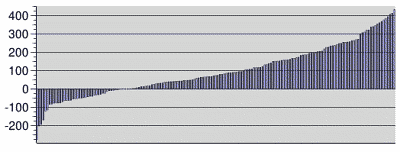
This sketch isn't that much better than an anecdote but it does at least give me a sense that while the power law is relevant to the blogging, there is — presently — significant upward and downward movement within the Ecosystem.
[030213: Update, Sifry has a great approach to limiting the effects of incumbency (via the power law) by also using the number of new incoming links to a site, "Basically, the idea is that for a relatively obscure blogger who has, say, 40 people currently linking to his blog, getting 4 or 5 new blogs linking to him can have the same effect as a a-list blogger getting 40 or 50 new links. "]
°2003.02.10.mo | Cambridge
 This is why I like living in Cambridge. Yesterday, Nora and I attended a lovely performance by the Harvard Middle East Music Study Group Ensemble. Tomorrow there's going to be a little blog-a-thon over at the Berkman Center. Wednesday the Art Interactive gallery is having a talk on From Cyborg to Data Body - Body and Identity in Digital Art by Christiane Paul. (While I helped redo the floor at the gallery, I think the inaccessible web site is a great pity.) Thursday the Balagan Experimental Film Series is showing a fascinating group of films on Objectifying the Body: Exploring Modern day myths of Aphrodite and Adonis. Fun!
°2003.02.05.we | Toilet Paper in the Ear
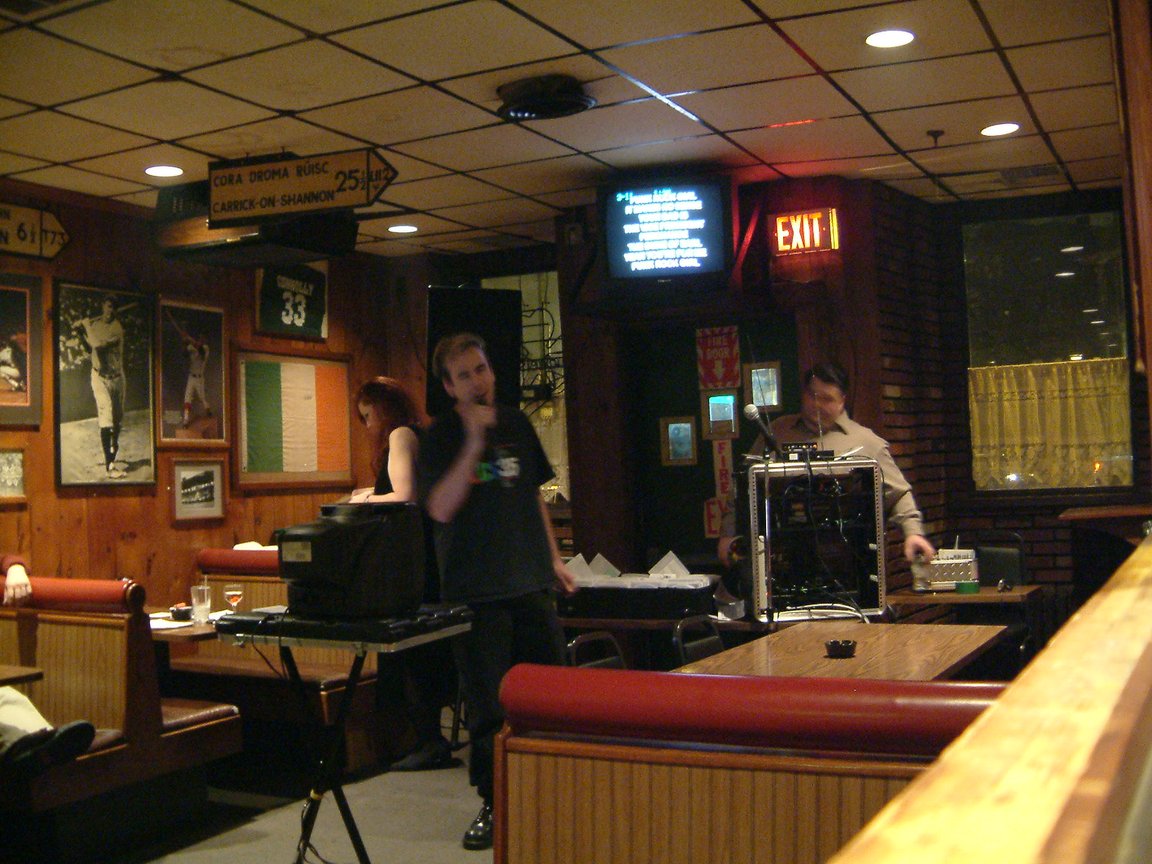 I sang my first karaoke at Triple D's, a smoky Irish pub full of toothless grins and gum snapping lips. I picked The Dead Milkmen's Punk Rock Girll figuring that no matter how much I sucked, I couldn't go wrong. I hoped those that knew the song might appreciate my nuanced portrayal of Rodney's broken highs. Those who didn't might still be sufficiently confused and not know whether to blame the song or me. In any case, I bet folks wished they'd brought ear plugs.
The next night as I lay in bed reading an old Cometbus I giggled aloud when I read about punks going to the emergency room to remove wet wads of toilet paper from their ear canals. I've used that trick many a time during a loud show and Nora recalled the night I got a wad stuck in my ear. Fortunately, if you know a computer geek there's one option before the emergency room: the alien extractors. In my repair kit there's a small pen sized implement that when pressed extrudes three prongs of hooked wire. It's truly scary looking and I never figured if it was good for anything other than picking hair out of the keyboard. But now I know: it's also good for removing toilet paper from your ear.
°2003.02.01.sa | Deadly Deceit
The present escalation of nonsense in the media regarding Iraq has encouraged me to finish a small essay on the relationship between Birds of a Feather: War and Deceit. I've been carefully reading through the history of the U.S. government's justification for aggression. I found that, "there have been few military actions undertaken by the United States in modern history wherein the true intent is consistent with the rationalized motive," as demonstrated in Japan, Cambodia, Cuba, Chile, Vietnam, and Iraq in the last decade and present.
Most Americans believe that we live in a country that is a sponsor of justice and democracy the world over. I used to believe this and that while sometimes we botched the job (e.g., Vietnam) at least our country had a certain integrity and noble intentions. However, as I began to read and travel more broadly I realized two things. First, I'm fortunate to be an American for whom the principles and reality of justice and opportunity converge. Second, many people in this country are not so fortunate, and in no way do our alleged principles guide U.S. foreign policy. I was safe from America only because I was within it.
But, deceit is not endemic to America. It's natural to all institutions of power and for that we need the constitutional mechanisms and civic culture to counteract it.
One simply can not trust what government officials say and they must be held to a level of scrutiny that — unfortunately — does not exist. Instead, these incidents show half a century of deceit and media failure because of a reliance upon government sources for information, little verification of stories before reporting them as predicates for aggressive action, and an acceptance of rationalizations that are merely excuses for a course of action that has already been planned.
__
[ January archive ]
Copyright © (2003) NrrrdBoy. All Rights Reserved. https://goatee.net/