
°2003.05.31.sa | An Off-Color Metaphor
 While speaking to someone about the effects of syndication and aggregators on a Web site, I was so bold to mention an "off-color" metaphor. How can sites that care about their brand, page views, and banner hits permit their content to be stripped of all design and served to generic aggregators/readers? Porn, again, leads the way, or at least isn't very far behind. SuicideGirls is a popular "indie" site that I'd heard of, but only investigated after reading a review in Bitch magazine.
I was impressed. Not only did I find what I expected (cute goths and punks), but writing and interviews with leading artists, writers, directors, and an amazingly vibrant community of personal blogs, message boards, chats, groups, etc. Everyone is able to post entries, form interest groups, and post photos of themselves. It wasn't at all creepy; it was more like a group of on-line friends. I figure there's little content that is more of a commodity than the prurient, but I bet you SuicideGirls retention rate is about as high as they come. If content becomes a commodity, community keeps them coming back for more.
°2003.05.30.fr | OSCOM3 and How Many is Too Many?
During the last session of the conference today there seemed to be two dominant questions. The first, what would be the next "killer app?" The second, there are over 75 Content Management Systems (CMS), is that too many? Since I recently wrote about the complaint of "too much stuff" in the Open Source world, I responded that the cacophony is a reflection of our vibrancy, and that the next killer app might very well be the next (76th) CMS to arrive on the already crowded stage.
The number of applications is sort of besides the point. As one participant noted, everyone has to give it a go as a "rite of passage." What is important was teased out in further discussion:
- A flexible and common framework would be of use. Instead of writing a new system, folks might choose to write a new feature, data-format, or plug-in for an existing one. Of course, a CMS have to accommodate the nuances of its organizational environment, for which there is no single model.
- Encourage folks to finish up. We need to focus our energies on seeing a project through, to the end, including good documentation and usability.
- Furthermore, the more flexible and transparent a application is, the easier it is for new developers (and users) to approach the project and make there own contributions, as can be seen with Apache.
°2003.05.27.tu | The Storrow Effect
 A tragedy of Boston is that the keystone of our park system, the Charles River, is bracketed by two highways: Memorial Drive and Storrow Drive. Getting to the river can be a death defying exercise, and massive trucks rushing by a few feet from one's narrow pedestrian path can take the charm right out of an evening walk.
Often, a public resource will be preserved from utilitarian exploitation for good reasons. Unfortunately, that preservation only lasts long enough to make it the likely victim of future pressure — and in this case, a victim of an imaginative parliamentary technique.
One of the most regretted decisions concerning the Charles was on the fate of the Esplanade, made possible by Helen Storrow’s donation of $1 million. "The issue was lively and divisive," writes Haglund, "the most protracted and public fight since the advent of auto traffic." Drafts for a highway along the Charles went back to the 1920s, but the plan for the Esplanade approved by the legislature in 1929 "provided that no portion of the new park should be used for roadway construction . . ." The Storrow Memorial Embankment was opened in 1935, giving direct access from Back Bay and the West End to the park along the river. When a movement to build a river highway reemerged in the late 1940s, a group of Boston residents organized the Storrow Memorial Embankment Protective Association. . . The Storrow Drive bill was defeated in the legislature by just eight votes in 1948. "But the defeat was short-lived," writes Haglund. "Two weeks later, the doors of the house chamber were locked. Then the house provided for the required three readings of the bill by adjourning twice and then reconvening. The roadway was passed by one vote."
- BU Alumni Review of Haglund's Inventing the Charles River
Perhaps the "Storrow Effect" is a related to the phenomena that new movements are typically named by their detractors: sadly, the road is named after those who had visions of green, not asphalt. And in the continuing theme of parliamentary tricks, last night I learned that some Congressmen also took to hiding under their desks during role call. When the Speaker begins locking the doors and identifying members by sight, that's when they resort to jumping out windows and fleeing the state.
°2003.05.26.mo | Jumping Out the Window: A History and Tradition
 Over the weekend I read William Speidel's (1968) Sons of the Profits: There's No Business Like Grow Business, The Seattle Story 1851-1901. If history were taught with such a regard for candor and human drama — and disregard for the stuffy, formalized myths of text books — no child could complain of a boring class. (The greatest pleasure of local history is learning of the funny and tragic stories behind the artifacts of our daily grind.)
With all the recent hubbub about the Texas Democrats fleeing the state, I noted that this is not a novel practice. Speidel wrote of the honored Abe Lincoln jumping out the window of the Illinois House of Representatives so as to deprive the Democrats of a quorum!
°2003.05.26.mo | A Change of Seasons
 For the first time in many years I missed the WWW conference — this time in Budapest, a place I'd love to visit — and the pleasure of seeing my international colleagues. But May always includes a change of seasons, both in the weather and in daily life. So, instead of Budapest I visited Philly for my youngest brother's transition: commencement from graduate school. (Hearing my kid brother talking about the trials of being a TA sure made me feel old!) I always figured Philadelphia was one of the reasons a friend of mine left her program at Penn. When I finally saw the horrible living conditions of my brother at Temple, I marvel that he made it at all. The first year he lived in a small stale room with only a tiny window looking out on a narrow alley surrounded by walls, chain-link, and barbwire. The second year wasn't much better.
 The month of May also means coming up with a new design for the next month. And unfortunately, May means finding a new roommate — Jason, too, finished his program. Fortunately, the warmer weather also means photographing people again. My recent fondness for objects, as noticed by Areta, is partly the result of cold weather and a lack of travel. Bostonians wrapped up against the weather aren't all that interesting!
And even bigger changes are on the way, already consuming much of my time...
°2003.05.20.tu | Protecting the President
This years batch of allergy medicine was accompanied by a new Notice of Privacy Practices from the pharmacy. Among the many reasons they might disclose my information, the final one is both amusing and frightening; my allergy medication can be disclosed to the government for "National Security, Intelligence Activities, and Protective Services for the President and Others."
°2003.05.20.tu | Jonesing for a Word
- jonesing
- 4. to crave something, not necessarily a drug.
Blogs have done me wrong: I can't get my on-line word fix. Yes, there are tokens of expression: thousands, millions, of them. But there are words, and then there are the tripping whispers of gods still dreaming.
My previous entry aside, I try not to trouble the reader with the trivia of my daily life. I know this is not the norm; I know I'm considered a prude for not linking to everyone and everything. But my "logging" of the day happens elsewhere; I want the creative entries to be a self contained evocation or manifesto. I strive for, and fall very short of, my favorite paper zines such as Cometbus, Word, and Burn Collector.
 In the 90s, Kiri used to be wonderfully opaque and evocative; as my eyes ran over her sentences, my mind would object that they were incomprehensible, but still my soul would swoon and visions would rise before me. Now, toothpickgirl is defunct, and Kiri's blog is half broken. Slander used to marshal words into a spit-fire of punk-fueled, theorist-laden fatwahs. But her posts are lagging, and while her blog's subject matter is still sharp, it's presentation is like so many others.
Granted, who am I to complain? People are busy, or move on with their lives. But even the old alleyways I used to prowl for new talent are gone: 404 dead-ends, or paved over in a 10-lane highway of blog tar. Ann, Au Jus, and Mimi aren't "on my palm" merely because they are my friends; they coincidentally happen to be one of the few places that occasionally help me out. But I want more. Quarlo gives me my visual fix, makes me jump up with a reason to live, but what of words? They taste best when read while blinking away the tears, and my well is overflowing with need.
If you've got a pure source, tell me.
°2003.05.19.mo | Uncommon Enthusiasms
Last night Nora and I checked out the Illegal Art show at River Gods, a new and nifty bistro in Cambridge. (Jonathan Zittrain, a colleague from my days at Harvard's Berkman Center, gave the introduction.) I particularly enjoyed Brian Spinger's Spin:
As a TV democracy, the U.S. is linked into one televised nation thought the use of Satellite feeds. These feeds carry the live raw TV image before it has been packed by the networks with music, graphics or commercials. Satellite feeds reveal images of TV personalities in from a live camera with open microphones before they go on-air and again during commercial breaks. Because the feeds are sent out unscrambled and are visible to over 4 million dish owners across America, anyone with a home dish can tune them in. The networks view the nation as one big patch bay on which they can spill feeds of TV personalities being made up, cajoling, primping and whispering. To the networks, these feed out-takes are trash, and to most home dish-owners, boring. To me, the feeds are a window into the construction and performance of character, and the floating TV talk-show called the 1992 U.S. Presidential election.
 Also, last week I had the pleasure to meeting Harvard bloggers Wendy, Derek, Sam, Vernica, Halley, and Jessica. Wendy makes for amusing reading and it's always exciting to meet librarians (Vernica and Jessica) — I suppose that's not something one hears every day! I'm very much enjoying Vernica's Thinking While Typingg given our mutual interest in local history collections and the Lindisfarne Gospels. I suppose unlike most people with a "Celtic" tattoo, I actually chose my pattern intentionally: those courses in Medieval and Christian history had some pragmatic utility after all!
°2003.05.15.th | Waiting for the Weather
 Millions of Americans are caught between sleep and the forecast: "Weather at 10". Of course, the present temperature is given at the top of the hour, but do "stay tuned for the 5-day forecast" ... and a butt load of commercials. I wonder if the advertising agencies have done studies on the suggestibility of tired suburbanites drifting into sleep while waiting for the weather.
°2003.05.15.th | Practitioners
I've become fond of the word "practice", in the sense of that stuff done by practitioners. Like "craft" it conveys the sense of applied understanding, the root of good engineering and many other things. On Ross Mayfield's blog I've noted a couple of papers such as Personal Webpublishing as a Reflective Conversational Tool for Self-organized Learning, and Informal Learning: The Other 80% and thought these too provide vectors to that which I find compelling.
 I've always considered myself to be "self-documenting" (e.g., my personal ethics, work style, and chairing style) and that term conveys a critical but not sufficient component of practice: the integrating cycle of learning, doing, and sharing. When I found a great book on the consensus practices of Quakers, I was thrilled to share it with my colleagues. And when they write up their experiences, or introduce me to something they find compelling (e.g., Extreme Programming principles, issue management tools, etc.), I feel professionally rewarded.
This week the memes of Clayton Christensen's book Innovator's Dilemma has been congealing with my experiences at the W3C, a Web standards organization. Christensen argues that successful companies are frequently displaced by smaller innovations that they are now too large to notice or take advantage of. (In my work, we often speak of successes needing to arrive "under the radar" such that they can stay focused but flexible during their critical gestation period.) The Web was developed "under the radar" of the then dominant IT industry and succeeded beyond many expectations. But now, the Web agenda is driven in part by the interests of those past successes. How does an organization like the W3C successfully stay attuned to the new, innovative stuff? Such organizations also suffer from the Innovator's Dilemma, but it's even trickier because it's even harder for them to control their own destiny. With standards, one is frequently gambling in a speculative space (which format/protocol is going to take off, particularly once you give it that little "standardized" boost), and you might even be throwing someone else's dice. As I think this question through, I'm a practitioner of my practice.
As a wanna-be scientist, practice means I get to formulate and test my pet theories without the need for a lab coat or super-collider.
°2003.05.14.we | "Misgivings About Social Software"
 Social software is another name for the endeavor of facilitating human interaction via computers. I'll defer the argument as to whether we need another name (I was writing about "social protocols" five years ago) and point out many of the concerns raised about the new media (with whatever name it takes) do not magically go away. New media do not necessarily make for a new world, just a different one. In a recent entry, Don Park expressed the concern that, "Social software could fragment human societies into clusters with sharply contrasting views of reality." This concern is a valid one, and as I wrote in January before "social software", before "blogs", and before "cryptoanarchy" the hype was about the Internet itself — of which we are now jaded — and its doppelganger then went by the name of "hyper-democracy".
However the ability of new media to both shrink and fragment the world stage goes back far beyond 1994 even. In his book Non-Zero: The Logic of Human Destiny, Robert Wright discussed the fragmentary effect of the printing press:
... By the mid-seventeenth century, the Netherlands was free from Hapsburg control, and the Holy Roman Empire was effectively dead. A primary cause was the centrifugal force of the printing press. The press mobilized religious dissent and political dissent, and often the two worked in synergy.
Still, to call the press a wholly fragmenting, decentralizing force would be to oversimplify. Instruments of efficient communication are tools for mobilizing groups that have something in common — a political aspiration, a religious belief, a language, whatever. If the commonality implies opposition to a central authtority, as it did for Luther's followers, the result can be fragmentation, or at least a diffusion of power. But if the group's common bond stretches across existing boundaries, bridging prior chasms, the effect can be to glue fragments together, to aggregate power.
The question is simply to what degree do new media permit community formation and fragmentation? And the answer need not be zero-sum: it can do both at the same time. Our challenge is to build the technology that achieves a robust mix.
°2003.05.14.we | International Trade
This morning on the radio, I heard an interview with Dennis Kucinich; if elected, he would be the first vegetarian President. That caught my attention. While it'd be a welcome change, it's not enough to secure my vote. He also mentioned scrapping the WTO and NAFTA. There are many things not to like about these treaties, but, in principle, I'm a supporter of international trade. As I wrote a couple years ago, my simple rule would be:
"Governments MUST NOT pass regulation that discriminates on the source of the product or service. Governments SHOULD pass laws regarding the quality and production of products and services." Consequently, a regulation that places a 30% tariff on grain produced over seas would be illegal. But a law that stated no grain may be sold that is based on a genetically engineered plant would be legal.
However, I wasn't quite sure where this principle was failing in implementation. Since then, I've learned much. I've learned how these organizations are used to supersede civil democracy and accountability, and to destroy sustainable production and exploit the displaced workers in special sweat-shop "free trade" zones in their own native land. And most frightfully, put the health and environmental concerns of sovereign states under the heel of corporate greed.
Chapter 11 of NAFTA introduced a little noticed principle of "regulatory expropriation." Ordinary expropriation is restricted to reimbursement for the actual "taking" of property by a state. In Chapter 11, "taking" means any expected future profit loss due to government regulation (including health and safety laws):
The most well-known Canadian case involving Chapter 11 was the Ethyl Corporation case, where Canada's decision to ban the import of the neuro-toxin and environmental pollutant MMT was challenged as "expropriation." In the middle of the NAFTA panel's deliberations, Canada threw in the towel, realizing that it was going to lose. Instead of risking a penalty in the hundreds of millions, it settled for US$19 million, apologized to Ethyl, and withdrew the import ban.
The "chill effect" created by this case may well have deterred the federal government from introducing other environmental or health-protection laws that would have suffered the same fate because they violated NAFTA's infamous Chapter 11. We have no way of knowing.
In effect, NAFTA and similar trade deals mean that such public policy choices are no longer even debated; they never see the light of day. As someone has remarked, they are smothered in their cribs by trade deal gatekeepers working in virtually every department of every government in Canada, the U.S., and Mexico.
This is not a theoretical issue; these references include more (frightening) information on how these powers work and their affect on the health of people in Canada, Mexico, and the U.S.
- Trading Democracy
- The NAFTA ruling on Metalclad vs. Mexico - The Broader Context
- Mexico vs Metalclad Full Reasons for Judgement Tysoe 22nd May 2001
I'm still a supporter of international trade, even when painful to a local economy, but when it's implemented by corporate cabals it's hard to like the results.
°2003.05.12.mo | Strange Musings
 Riding a bike augments one's perspectives on things. Today I was wondering what it would be like to be hit by a new Volkswagen Beetle? Would I just roll over the top and land on my feet like magic? Or roll off the front and end up under the wheels? If I can't make it over that VW hill, I'd rather end up on the spacious hood of a big honking caddy.
°2003.05.11.su | The Logic of Fundamentalism
There's a certain elegance to the arguments of fundamentalists arising from a strict — though conveniently selective — application of consistency. Two of my favorites are:
- Caliph Omar when asked for orders regarding the burning of the Library of Alexandria's holdings is alleged to have stated, "they will either contradict the Koran, in which case they are heresy, or they will agree with it, so they are superfluous."
- Papal Legate Arnaud Amalric when asked about the Cathars (Christian) in Beziers during the Albigensian Crusade is alleged to have stated, "Kill them all. God will recognize His own."
 Yesterday, I read that Justinian's recapture of Rome from the Visigoths, who are traditionally blamed for the "fall" of Rome in 410 CE, did more damage to Rome than the original capture by the "barbarians." Seemingly, religion and war are two human phenomena highly susceptible to fundamentalist rhetoric.
°2003.05.10.sa | Wha'da ya Know
If there's one thing that having photos on this site has taught me, it's that there's no accounting for taste. Yesterday, "Jake and Simone" took the time to write to me, "we found your webpage and..uh....you look fucking retarded. thanks for a laugh." I bet they meant the same photo that generates some of my fan mail, and the one that folks have asked if they could include in their school report (when talking about the Web) or be used as someone's (rather sinister) role playing game character. Not that this should impress you. But clearly there's a difference of opinion. Go figure.
And despite my employment of a bandwidth smack-down against idiot boards, two days ago a single thread on "cute chicks with glasses" managed to raise my bandwidth by 150M a day by including links to the bespectacled Nora. These weren't even in-line links wherein my photos appear on someone else's pages, but explicit URLs to the images. Folks had to click the links, and then refresh in order to even see the image. Otherwise, as one person reported, "I cannot watch the pics. Every time I get a "You don't have permission to access /photo/gallery/... on this server" message. :-("
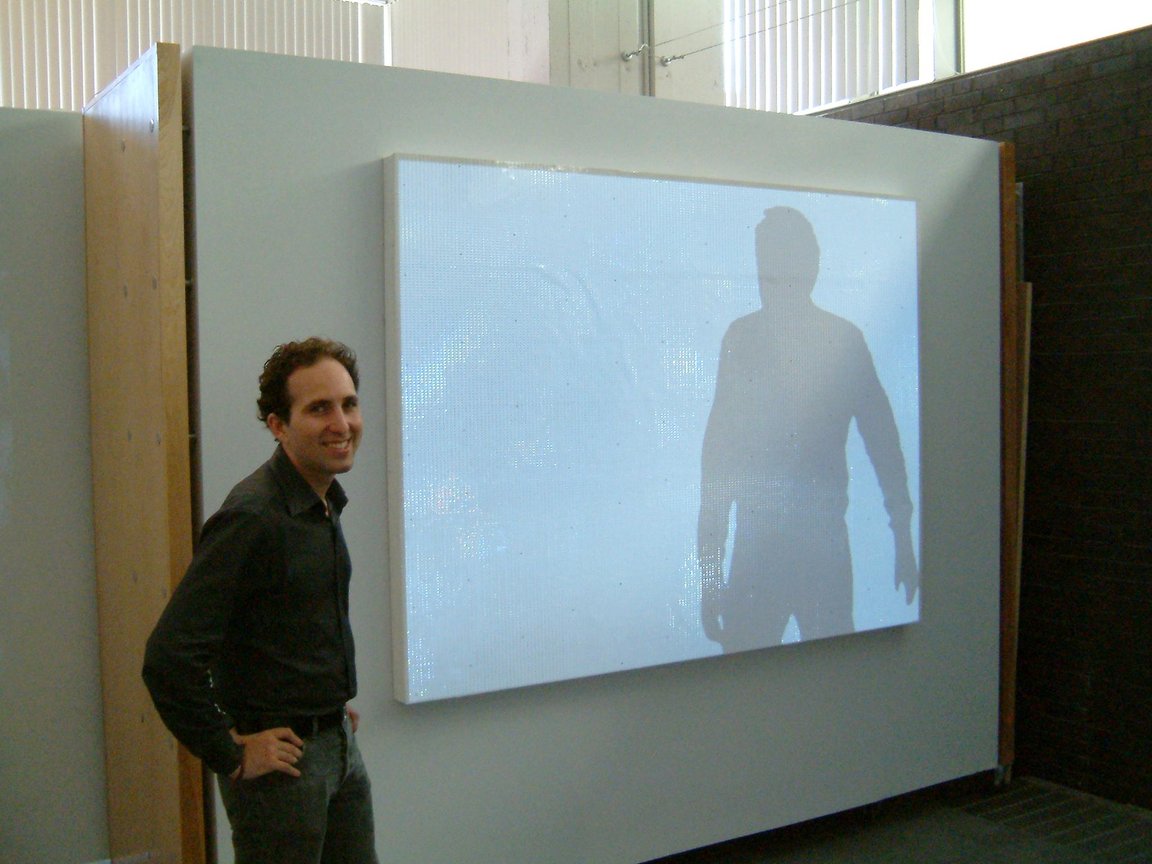
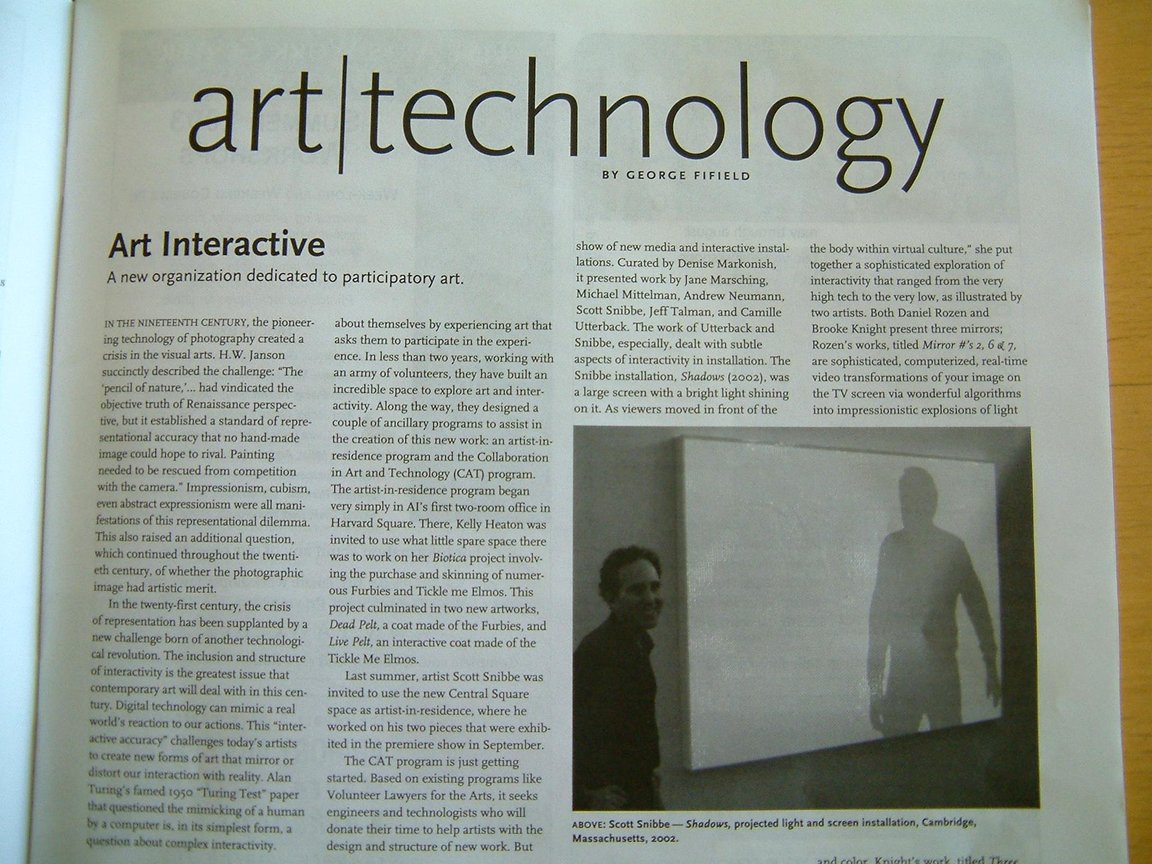
A couple of times I've seen my photographs appear in places I hadn't even expected. Once while walking down MIT's infinite corridor I recognized my photograph of a peace rally posted on a message board. Today, I stumbled upon my photograph of Scott Snibbe and his Shadows piece at Art Interactive in the magazine Art New England. Wha'da ya know.
°2003.05.08.th | Good Riddance
The smoking ban in Boston is now in effect, giving me more opportunities to go out and some press exposure to an insightful friend:
i'm happy that i can work in a smoke-free environment. when you work in a bar, you are basically in denial of the fact that you are in a poisonous environment. you can romanticize it, you can color it however you want. i'm sure i've said this before, but alcohol and cigarettes are happy toxins. alcohol on its own and in moderation only hurts the drinker. (let's keep addicts and operating machinery out of it for now.) but cigarettes don't just affect the smoker. i'm sure that a lot of restaurant workers start the same as i did. you find a job that is flexible and pays well while you do other things. it's not a career, it's just temporary. next thing you know, 3 years have gone by. and you relegate the dangerous aspects of things like second-hand smoke to the back of your head because it's just temporary and you can stop any time. you breathe in, you take it in, but it's really not a part of you ... or is it? - Au Jus
She's quoted in a Boston Globe article entitled "Where there's smoke, it must be Cambridge". Dare I dream of being able to dance at the Cambridge goth club without returning home reaking of smoke and with a nose full of black boogers?
°2003.05.07.we | Law and Loyalty Day (Again)
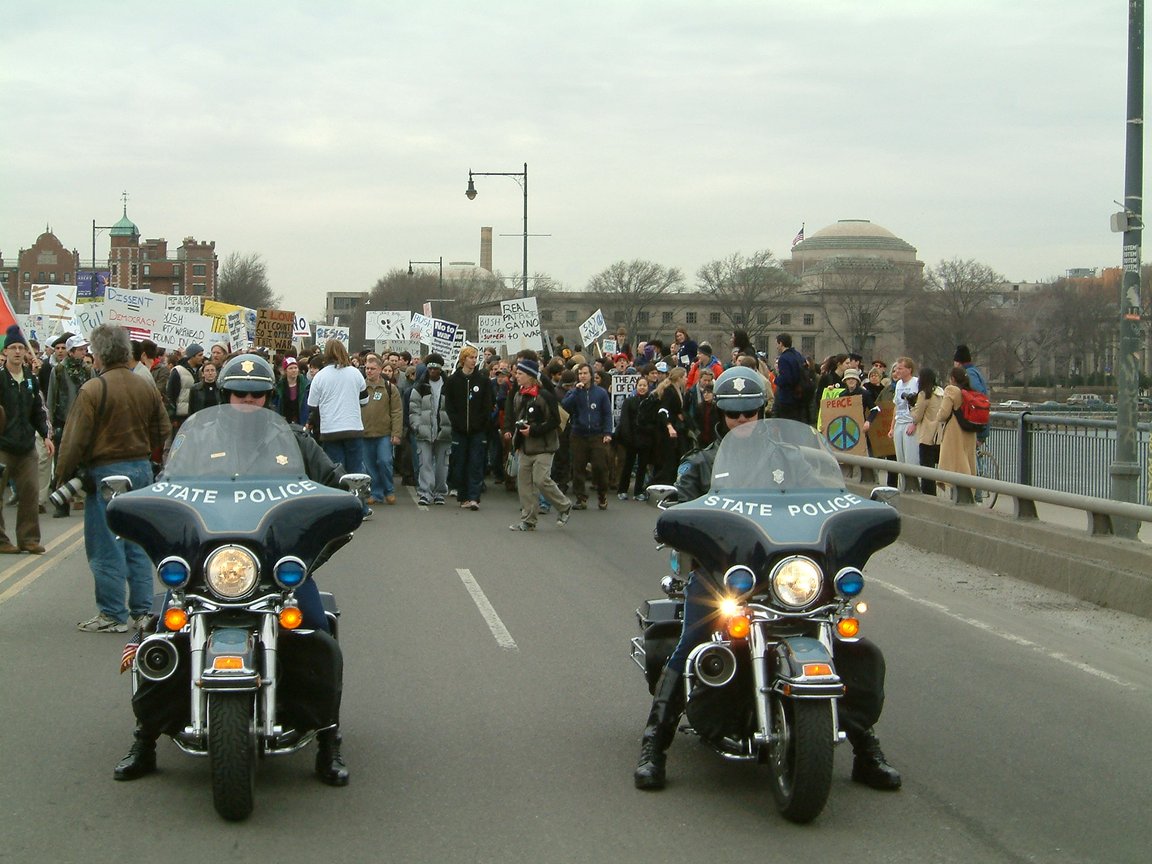 Last year I noted the efforts to suppress the very notion of a May Day, and its historical roots in conflicts about unresponsive government beholden to corporate interests. The result of that earlier tension? Demonstrations, massacres, and the trial and execution of labor organizers for their political beliefs. During the Cold War hysteria conservatives attempted to supplant May Day with Loyalty/Law day, and it's not surprising to see those efforts renewed in the past decade. This year the proclamation is issued by a President that pins American flag to his lapel.
"This Loyalty Day, as we express allegiance to our Nation and its founding ideals, we resolve to ensure that the blessings of liberty endure and extend for generations to come." - Presidential Proclaiming of George W. Bush.
If only it were true.
°2003.05.01.th | Libraries I Have Known
I don't recall much about my elementary school library. It was an open "media center" where we had an occasional lesson. It's the place where I had my first exposure to illicit drugs and raw brains: props demonstrating the evils and consequences of drug use. I remember briefly handling the plastic bags with slices of cancerous brains and lungs and thinking our greedy little hands had wreaked more damage than a "pack a day" ever could. The myriad of empty colored capsules were beautiful and confusing and I despaired that I'd ever be able to distinguish between them all. How could some depressants make you seem hyper, and stimulants bring you down?
My actual reading fix was sated with my mother at the public library. I remember breakfast at McDonald's on a teacher's treat, and attending an awards ceremony with my father where I got to meet McGruff the Crime Dog. I can't recall what he had to do with books.
In middle school I became a library helper: a little fascist. Shushing those who were too loud and the exercising the authority of the red stamp and five cent fine. The kindly librarian would let kids slide, but I knew their tardiness hinted of deep character flaws and those nickels were the funds for our fevered expansionist schemes: teenie-bopper plans for world library domination.
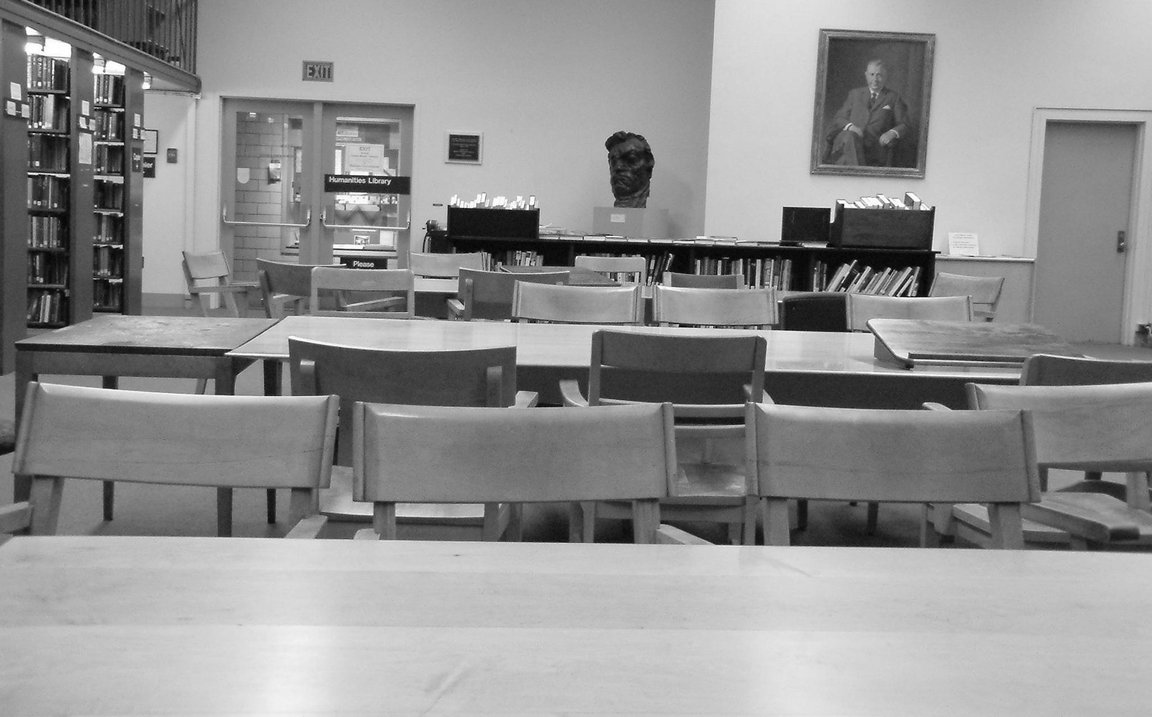 In high school I never bothered to be a "helper" — been there and done that. But in time the librarians trusted me enough to let me close. On hot summer days I preferred the library's air conditioning to the afternoon's heat. This was the last time when I could honestly say that I regularly read every periodical in a library. It was the first time I learned how easily a plastic card could be slipped between a lock and door frame when I wanted to look at a back issue kept in the inner office.
Much of UMBC had been built after the 60's; it was planned with plenty of tunnels and sniper points for state troopers, should they need to put down any future student revolts. This also provided me with many adventures and easy access. Once I was in the tunnels, the library could be accessed via it's own basement storage area and, after crawling under a shelf of journals, the periodical section. Other floors could be had if one avoided the motion sensors. Again, I took pleasure in the fact that I could access books whenever I chose, though I never did. (It's not like I was a stranger there during business hours!) I once took a friend there and he decided to permanently borrow. When he told me of this as we traced our way back home through the tunnels, I seethed. He finally yelled, "Fine Joe, if I know you were going to be this pissy about it I wouldn't have taken them in the first place." We took them back, and we didn't talk for a week.
Frankly, I was disappointed in the tunnels of MIT. (There aren't that many genuine tunnels, just basement hallways and a couple of roof access points which do provide an awesome view of Boston.) So in graduate school I was less interested in the structure of libraries, and more with the personalities of its denizens. Finally, a place of the equally obsessed. A place were students who had graduated decades ago never left, but spent their days doing research — or brushing their teeth — in the library, and their nights talking with friends and sleeping on the sly in the all-night coffee house.
[Update 030502: My mom tells me it wasn't McGruff the Crime Dog, but the MS Read-A-Thon Mystery Sleuth]
__
Copyright © 2003 NrrrdBoy. All Rights Reserved. https://goatee.net/